Workflow blueprint
The five-stage pipeline that runs every channel. Plus six rules the pipeline enforces automatically - one per failure that cost real time or money to learn.
The pipeline
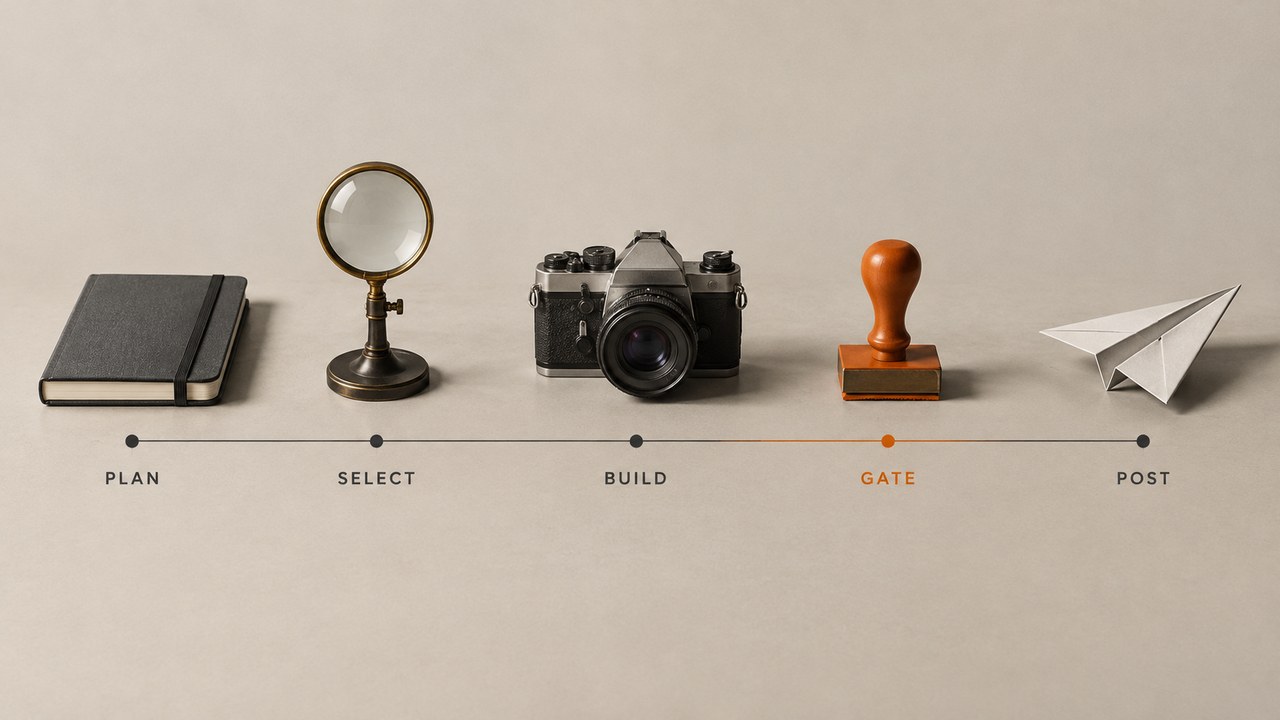
Plan, select, build, gate, post. Every episode on every channel goes through these five stages. The gate is the load-bearing one - that's why it carries the only warm colour in the diagram.
The six rules
Each rule closes one class of failure. The cost is the proof - real time, real money, or real defects that would otherwise have shipped.
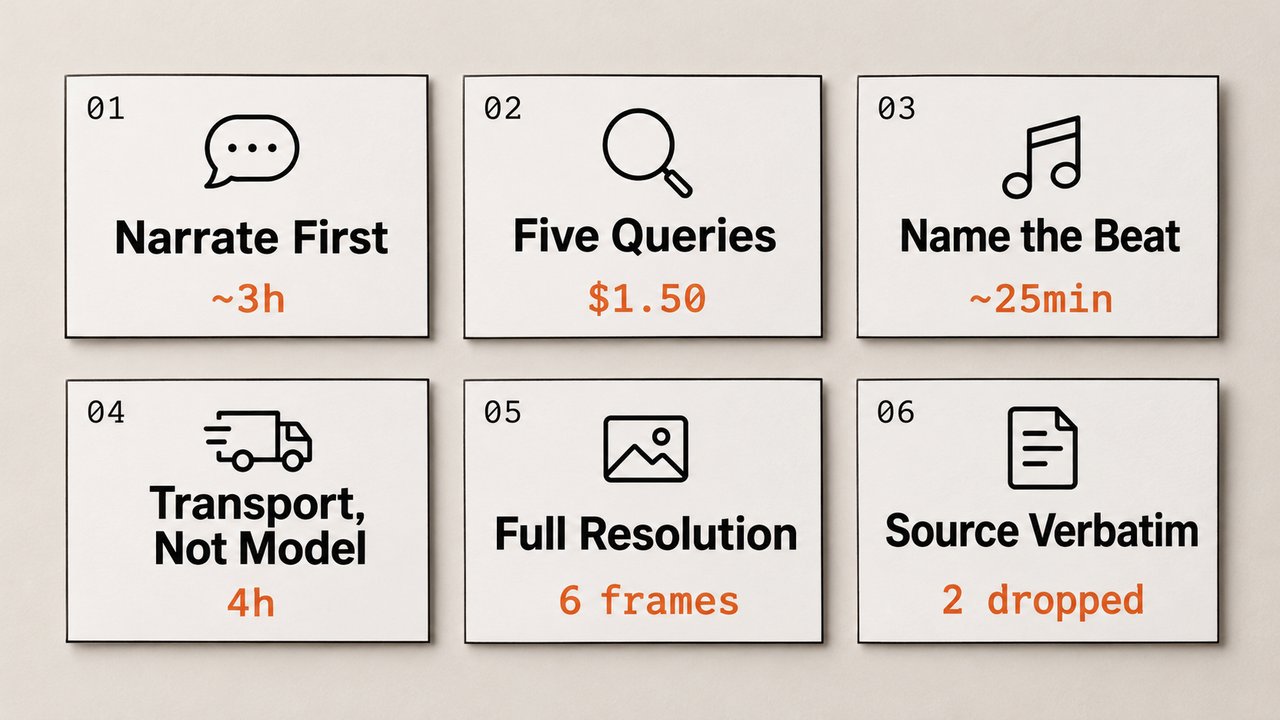
Estimated beats never match the TTS pauses. Plan after the audio, not before.
~3h saved per rebuildIdentical queries put the same 50 jpgs in every folder; the selector dedups globally, so half the needs see nothing.
$1.50 saved per rebuild"No Kanao" rejected the very need whose line is "Then he met Kanao." Constraints are per-beat, not global.
~25min saved per re-SELECTA timeout reads as a model fault unless the selector logs transport separately. The selector never silently swallows stderr.
4h saved per debugging sessionSix frames passed at 640px and failed at full resolution. Confirm any "wrong character" call by opening the source PNG.
6 frames caughtA claim only goes in if the source states it. Two claims dropped from Musashi for being unsourced; one added to Speedmaster because it was sourced.
2 claims cut for honestyThe QA gate that actually runs
The gate runs ResNet50 cosine similarity at three frame positions per scene, then asks a vision model for a modern/anachronism check. The pass/fail criterion is calibrated against the reverse-engineered luxury episode:
| Scene | t = 0% | t = 50% | t = 98% |
|---|---|---|---|
| s1_establish | 0.325 / 0.317 | 0.324 / 0.316 | 0.329 / 0.320 |
| s2_deepen | 0.335 / 0.327 | 0.353 / 0.346 | 0.369 / 0.362 |
| s3_exit | 0.231 / 0.230 | 0.228 / 0.226 | 0.211 / 0.213 |
The numbers are vs-seed / vs-hero. The third scene has the lowest scores and that is correct - a character walking away should diverge from the reference. The gate flags catastrophic divergence, not stylistic movement.
What the workflow proves to a brand
A brand evaluating this work signs off on "the character looks like the character" - not on the mechanism. The blueprint is the proof that the work is auditable end to end: every claim traces to a source, every frame is gated against a reference, every rule has a name and a measured cost, and every failure mode is documented.